



Original price was: $23.39.$16.37Current price is: $16.37.
- Safe Payments, the Smart Choice
- Shop with Confidence, Pay Safely
- Protecting Your Payment Information
- Quality products, fair prices.

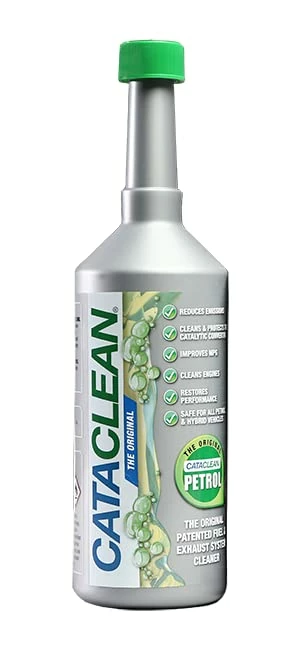
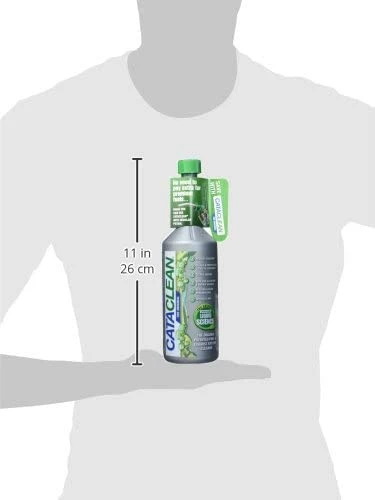
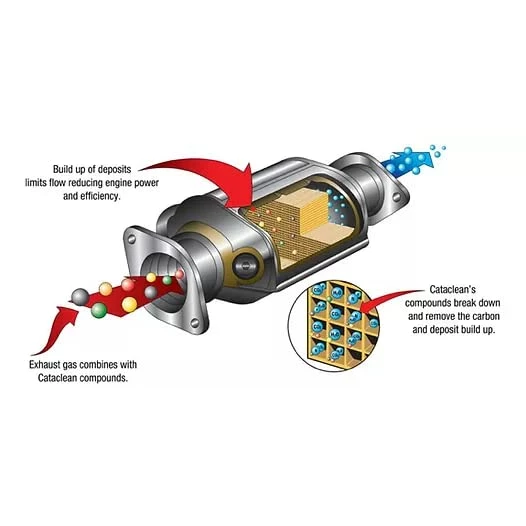
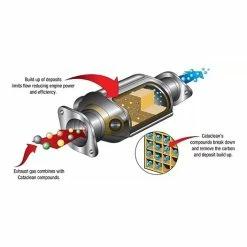
Mr. Gasket Cataclean is a fuel and exhaust system cleaner that reduces carbon build-up and cleans your vehicle’s catalytic converter, oxygen sensors, fuel injectors, and cylinder heads. Cataclean does not alter fuel composition and is safe for gasoline, diesel and hybrid engines. Testing at an independent emissions testing facility showed using Cataclean can lower your total hydrocarbon emissions by up to 50 percent (performance results are dependent on driver habits and vehicle condition). Use Cataclean to fix drivability issues such as power reduction, hesitation and hard starts, as a pre-treatment before an emissions test or to extend the life of your vehicle engine. Using Cataclean may help to avoid the replacement of costly oxygen sensors or your vehicle’s catalytic converter. If you have to replace your catalytic converter, use Cataclean with the installation to extend its life. Cataclean is easy to use-simply pour in your fuel tank. Cataclean is 50 state legal and complies with VOC (including California) and OTC regulations, as well as Federal low sulphur content requirements for use in diesel motor vehicles and non-road engines. For optimum performance and protection, use Cataclean four times a year. Made in the USA.
- Using Cataclean can lower your total hydrocarbon emissions by up to 50 percent
- Reduces carbon build-up in catalytic converter, oxygen sensors, fuel injectors and cylinder heads which results in improved fuel efficiency
- Improves overall vehicle performance-including driveability issues such as power reduction, hesitation, rough idle, hard starts and lost fuel economy
- Safe for gasoline, diesel, hybrid and flex-fuel vehicles; does not alter fuel
- Not for use in 2-stroke or oil / gas mix engines
5 reviews for Discount ⌛ Cataclean 120007 Complete Engine, Fuel And Exhaust System Cleaner, 473 Milliliter (Packaging May Vary) ⌛
Add a review
Related products

Cleaners
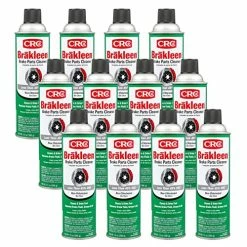
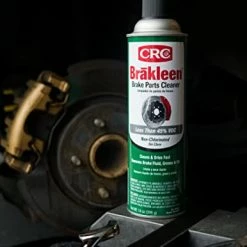
Hot Sale ✔️ CRC (05084-12PK) Brakleen Non-Chlorinated Brake Parts Cleaner – 14 Oz., (Pack Of 12) 👏


Lisa Lamascus –
Here’s the quick summary: Yes I used this and yes my car passed smog test…. but I would try lots of other things before using Cataclean again.My vehicle is a 2004 Toyota Sienna with 137,000 miles. Check engine light (CEL) has been on for two years now. The CEL is on due to the following codes P0420 – Cat Bank 1, P0430 – Cat Bank 2 , P2238 – AF Sensor Circuit.This year we got the registration renewal and were required to get a smog certificate. Since you can’t pass smog test with CEL on, we took the van to the dealer to see about getting it the CEL fixed. The dealer recommended replacing both catalytic converters the A/F sensor and calibrate ECM. All for a cost of over $2,800.So instead of spending the $2,800 I figured it was worth it to give Cataclean a try. I followed the directions and added the entire contents to about 1/4 tank of gas. Then immediately drove the van until it was empty. The van was not completely empty, but the yellow fuel warning light did come on and the gauge was on E. At this point I filled up the tank with premium gasoline. After filling it I immediately drove the van for about 40 miles. I was expecting the CEL to turn off but it did not.At this point my story gets less normal than most I suppose. My wife drives this van most times and I have another car. It just so happened that my wife was sick with a bad case of the flu and she did not drive the Sienna for more than 1 week. So the Sienna sat with nearly a full tank of fuel and whatever was left of the Cataclean for 1 week.After 1 week of sitting in the garage, I decided it was time to try to drive the van and see if the CEL would turn off. This is where it gets very weird and discouraging and expensive. I pulled out of the garage and the van barely ran at all. It felt like only half of the engine was running. The engine had very little power and to make matters worse the CEL was now flashing ON and OFF. I pulled over and did some quick research on my phone and found out that a flashing CEL is bad news. I spent the next 4 hours “babying” my car. I would drive it for a little bit and the CEL would flash. So I would pull over and let it idle next to the curb. When the engine was simply idling the CEL would not flash. I did this for hours and hours and the CEL flashing got less and less prevalent. Finally the CEL stopped flashing after about 4 hours of driving and idling. If this does happen to you, you need to be very careful. Driving with a flashing CEL could lead to really expensive damage and even your car catching on fire.After that long evening of babying my car, the CEL never flashed again. But the car did not run correctly after that either. The car was rough at idle and vibrated a lot while it ran. And now, my car had a new code P0354. I took it to a mechanic and he replaced the #6 ignition coil and spark plug and cleaned the fuel injection system. This made the car run smooth and cleared the P0354 code. Replacing the ignition coil spark plug and cleaning the fuel injection system cost $510.I had a lot of expensive problems after I put in the Cataclean (see above). These problems could have been a coincidence and I could have had those problems without the Cataclean. After all, it’s an old vehicle with lots of problems. Anything is possible. But I don’t think I will be using Cataclean again.I cleared all codes and tried to run the monitors. For those of you not familiar, there are “monitors” which run in software on your vehicle. These monitors must be run and passed with no codes before you can have your car smogged. If the monitors generate codes, then the CEL turns ON. If you clear the codes, your CEL does go off, but your monitors are now “imcomplete” in your cars OBD memory. You cannot pass smog with incomplete monitors (actually the number of incomplete monitors allowed to pass smog varies from state to state so check with your motor vehicle department). You can find the rules for California here: […]So now my car runs smoothly, the Cataclean has run through the emission system and the CEL is off. I have two incomplete monitors. One of the incomplete monitors is the Catalytic Converter monitor. So I then drive the van around town running some errands. Mostly stop and go, but some highway driving. After about 50 miles the CEL turns ON and generates code P0420… very discouraging. But I did not give up. I cleared the P0420 code and decided to try nothing but highway driving at moderate speed. Just a hunch I guess. So I got on the freeway and drove. Entirely freeway driving at very moderate speed. I got in the slow lane with the trucks and probably averaged 55 MPH and for it’s worth I turned my Air Conditioning off. I did this for about 75 miles. I kept checking the scanner to see if the monitor for the Catalytic Converter had run, but it said incomplete. I must have checked the scanner 30 times to see if the monitor had run. Then it happened, the Catalytic Converter monitor ran and the status went to OK with no code. As soon as the monitor ran with no code I found the first smog station I could find and got a smog certificate. YEAH!!!!In order to do all of this I needed an OBDII scanner with me in the car to check monitors, read codes and clear codes. I used a very inexpensive OBDII scanner that I bought at Wal-Mart for $21. I think some of the inexpensive models offered on Amazon would work as well. You don’t need an expensive scanner to do this. The main thing for checking monitors is a feature called “I/M Readiness Status”– make sure your scanner can do this function.So did the Cataclean help pass smog? Did Cataclean cause the damage to the ignition coil? Did not driving it for a week in the middle of this process cause a problem? …. I don’t know. If I were to ever need to use Cataclean again, I would drive the vehicle… a lot and try to get it through the system as quickly as I could. Hopefully, I won’t need to use it again.
T.J. B –
I’m an ex-mechanic, recently my daily driver has been showing signs of failing/clogged cats. I bug bombed the truck with another product I use religiously with not much difference. I’ve had a po420 pop up occasionally, poor mileage, hesitation etc. Got the tank down to 4 gallons, added contents and drove for about 20miles mixed driving and a couple WOT pulls in the process. Although the instructions say to drive normal, I took it upon myself to be hard on the truck considering rpm/heat/load help keep cats clean. Every full throttle pull resulted in a burnt carbon smell so it’s proof it’s doing something. The truck does run better and is downshifting less to gain speed, I’ve yet to fill up again so i can’t say yet on if mileage has improved. I may try another treatment just to see if it helps. For anyone else wondering as long as your cats are not rattling there is a chance of them being revived, or going a little bit longer before replacement.
Javier Guzman Jr. –
I can tell that it cleans my catalytic converter a bit.
MG –
I have a Honda pilot with over 200K miles. The dreaded P0420 code came on and set the check engine light on. I ran the tank down to about 1/8 tank and added the bottle. I then drove approximately 18 miles (mostly freeway at about 2-3k RPMs) then fueled up. By this time my fuel light was on so I probably used this a little more concentrated than the instructions state on the bottle. I drove a few miles after fueling up and the check engine light turned off; after a restart, the light remains off. The stuff actually works and I am not looking at replacing my cat now, phew!There are some videos where Scotty Kilmer runs a gallon of laquer-thinner through the tank of cars showing P0420 codes and that is supposed to work but I just couldn’t do it. Scotty does mention that our fuel has ethanol in it already anyway. If you are a car person then you have probably seen some of his videos. There are also videos showing what happens to rubber gaskets when they are exposed to this as opposed to laquer-thinner etc and it definitely weakens rubber gaskets. If you are the paranoid type then go check those out first. This bottle of Cataclean states that it is safe for gasoline & diesel motors and this is made to be mixed with fuel. This felt safer than trying the laquer-thinner and I’m glad I went this route.Bottom line is it works on a high mileage vehicle with the original cat in my case and I am surprised & glad that it did. I would use again on a vehicle with P0420 code.
Karate Bear (CT USA) –
I drive a 2006 Honda Civic Hybrid with 220,000 miles. Emission testing was coming up and my CEL (check engine light) flared up. I used my BlueDriver App & OBD2 device scanner (which I highly recommend for reliable feedback on your car) and it gave me the dreaded code P0420 (Catalyst System Efficiency Below Threshold Bank 1). I took the care to the local Honda Dealer which said the only solution was to replace the Catalyst Converter (like $1900 for the part and $600 labor + tax = $2600 or so).A friend recommended I try Cataclean 120007. I followed the instructions to the letter (1/4 tank full, pour the entire Ctaclean bottle, drove 15+ miles, filled up the tank and cleared the P0420 code). After driving 100 miles the PO420 code came back. I cleared it a second time and drove another 150 miles and it stayed off.I ran the “Smog Check” program on BlueDriver (simulate what your Testing Emission Center would see) anew and it passed the Catalyst Check. I just received my Emission Testing Pass a few days later for $25 for Cataclean vs. $2600 for Honda…I will continue using CataClean once a quarter and from now on, only filling up at Mobil as they have the highest concentration of additive vs. cheaper $/gallon brands which should help drive this car for another 80k miles.I hope the above helps some of you,